

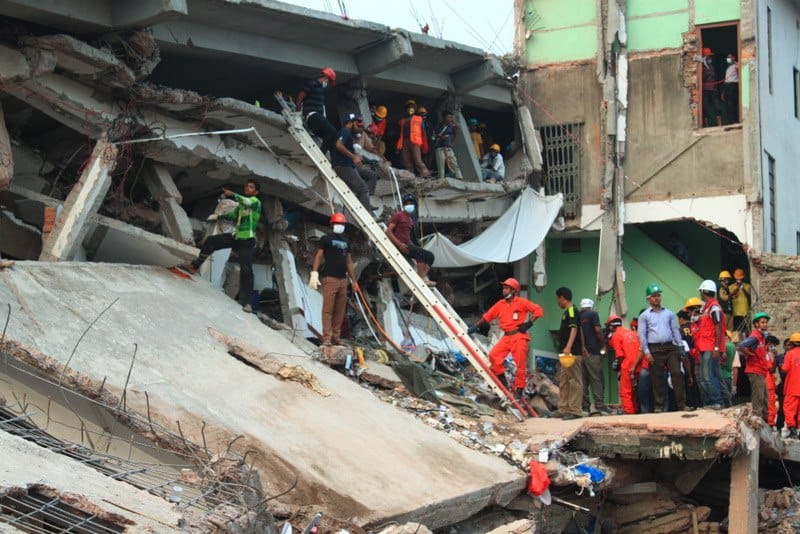
On 24 April, the world will mark the 12th anniversary of the Rana Plaza collapse in Bangladesh. In just 90 seconds, the disaster claimed at least 1134 garment workers’ lives – most of them women – and injured thousands more.
Rana Plaza is remembered not only as one of the deadliest industrial disasters in history, but also as a stark exposé of the deep global inequities that continue to shape the global garment supply chain.
Read more: Fashion industry embraces sustainability and ethics as consumers demand: “Who made my clothes?”
Rana Plaza was an extreme and visible manifestation of violence, but violence and exploitation still persist throughout the garment sector. It continues in quieter, less obvious ways – in factory fires, unpaid wages, withheld festival bonuses and the daily insecurity that shapes workers’ lives.
Tragically, a factory fire in a Dhaka factory and warehouse in October 2025 claimed 16 workers’ lives. Likewise, ongoing disputes over Eid ul Fitr bonuses serve as reminders that exploitation remains common.
As reported by the Daily Star in March 2026, 31% of garment factories in six major industrial zones had not yet paid the legally-required Eid bonuses.
These are not mere administrative oversights, they’re symptoms of a system that normalises extracting value from women’s labour while denying them basic rights.
Our recently released study, titled Civil Society, Multiple Publics, and Relational Recognition: Recognising Women Garment Workers and Organising Situated Responsibility in Bangladesh’s Apparel Industry, highlights the harsh reality. Indeed, in the decade since Rana Plaza, the rights, dignity, and recognition of women garment workers remain fundamentally unresolved.
This failure matters. Women workers are not marginal to Bangladesh’s garment industry, they are its backbone. Their labour has been crucial in transforming Bangladesh into a leading player in the global garment economy.
Their labour supports a multibillion‑dollar industry that drives global fashion markets, yet their lives and rights continue to be systematically devalued.
The danger of daily invulnerability
Drawing on a seven-year study, our study demonstrates how women garment workers are routinely marginalised through persistent misrecognition and non-recognition. These are not abstract concepts; these forms of exclusion translate into daily vulnerability including exposure to violence, unsafe working conditions, economic insecurity, gendered violence and limited access to justice.
We argue that responsibility for this ongoing harm has been systematically evaded.
Brands, industry actors and the state continue to deflect accountability within a global supply chain structured around relentless cost-cutting, weak regulation and poor enforcement. In this context, women workers are compelled to bear the unseen costs of cheap fashion.
They subsidise global consumption with their bodies, labour and, too often, their lives.
Against this deep-rooted injustice, our research highlights the crucial role of civil society actors, including academics, trade unions, NGOs, activists and media organisations, who refuse to let violence and exploitation stay hidden.
Historically and currently, these civil society actors operate across local, national and global levels to hold responsibility where formal accountability systems fail.
Through campaigns, advocacy, documentation and public debate, civil society actors reveal the lived experiences of workers that are otherwise erased within corporate and state narratives of “ethical sourcing” and “post-Rana Plaza reform” and “compliance”.
Where the state and industry fall short, civil society becomes a space of struggle for recognition. By mobilising dialogue and public pressure, these actors seek to hold brands, factory owners and government institutions accountable.
Their demands are clear and urgent – a living wage, safe working conditions, freedom of association and genuine respect for workers’ rights.
The role of trade unions
We highlight how central trade union federations, both registered and unregistered, are vital to these struggles. The unions oppose the authoritarian regime, when most suppliers are politically-connected, by humanising production and emphasising the realities of women workers’ lives.
While women’s labour is valued as an economic asset, their status as rights-bearing workers remains highly contested. Union organising is routinely constrained at the factory level, giving women workers few opportunities to gain representation or challenge exploitation.
Recognition, as we show, is often triggered by episodes of mass violence and by global visibility, such as the Rana Plaza collapse. Yet, it’s rarely sustained as an ongoing practice. While at the local level recognition occurs, at national and global levels, it remains uneven and reactive.
Compliance regimes and private regulation have tended to contain workplace tensions. As a result, workers’ struggles for recognition and representation remain unresolved, even after more than four decades of industrial growth.
If recognition is to carry meaningful significance beyond mere symbolism, we argue, it needs to be sustained, organised and collective across interconnected levels of civil society engagement.
Responsibility cannot be episodic or symbolic; it must be organised, relational, continuous, and enforced throughout the entire global garment production system.
We situate the argument within civil society organisations to explore how responsibility is organised and how accountability is demanded within the global garment industry.


