


This year, the United Nations’ Slavery Convention turns 100.
Yet, what is most jarring in taking stock of the century-long developments flowing from the 1926 Slavery Convention is – as our research has shown – that nearly half of all countries have yet to criminalise slavery in their domestic law, despite having international obligations to do so.
To seek to address this shortcoming, on 25 September, the centenary of the adoption of the Slavery Convention, Monash University, together with Nottingham University launched the Anti-Slavery Model Legislation, meant to assist countries by providing guidance to legislators around the world as to how best to outlaw slavery and the other forms of human exploitation that have since been prohibited by international law: forced labour, servitude, the slave trade, and ‘institutions and practices similar to slavery’.
Despite this large gap that currently exists between the international obligations that countries have undertaken by agreeing to the 1926 Convention and other instruments since, as opposed to the limited up-take in addressing these forms of exploitation in their domestic law; the long view should recognise that the legacy of the 1926 Convention is trending positive.
This is so, as over the last twenty-five years, the successive waves of focus on ‘human trafficking’ and ‘modern slavery’ have laid emphasis on addressing human exploitation, of which its apex manifestation is slavery. During this period ‘slavery’s twentieth-century problem’ has been solved, clearing the way for new pathways for addressing human exploitation including those to emerge from our Antislavery in Domestic Legislation platform.
The 1926 Slavery Convention
The development of the 1926 Convention by the League of Nations can be traced back to the late Nineteenth Century European ‘civilising-mission’ ethos of the ‘Scramble for Africa’, which was often justified through addressing the slave-trade on the African Continent; with Ethiopia as one of the few countries that remained independent when the dust settled.
Although France, Italy, and the UK had from afar carved up spheres of influence over Ethiopia in 1906, a proposal was made in 1922 to make Ethiopia a Mandate – effectively a colony – of the League of Nations itself. With that suggestion thwarted in 1923 by the admission of Ethiopia to the League as a Member, the focus that had been on slavery became generalised in nature and moved instead towards the development of an international slavery convention.
As its provisions make plain, the 1926 Slavery Convention was designed to secure “the complete suppression of slavery in all its forms and of the slave trade by land and sea” while seeking to “prevent forced labour from developing into conditions analogous to slavery”. In so doing, it required countries that adopted the Convention, via their domestic laws, to impose “severe penalties” for infractions.
The Genius of the 1926 Convention
In law, words matter. It is here, in regard to the actual definition of slavery found within the 1926 Slavery Convention, that this instrument has revealed itself as one of the finest vintages of international law, only coming into its own after having aged for nearly a century.
That revelation comes down to the genius of the actual wording of the definition of ‘slavery’ as set out in the 1926 Slavery Convention. That definition, it is worth noting, remains the accepted understanding of slavery in international law, having been considered and confirmed by countries both in 1956 and again in 1998.
The definition, as found in the 1926 Slavery Convention, reads:
Slavery is the status or condition of a person over whom any or all of the powers attaching to the right of ownership are exercised.
At first glance, the definition appears to emphasise the ‘right of legal ownership’; yet, since 2005, courts have been more nuanced than the European Court in interpreting these provisions.
Prohibition of Slavery in Domestic Law
The Twenty-First Century recognition that the 1926 definition addresses both de jure and de facto instances of slavery means that it is not enough for countries to abolish any laws that allow for slavery, it also requires them to actively legislate, passing laws that prohibit slavery.
The 2016 findings of the Inter-American Court of Human Rights spurred us on to develop a dataset of national laws so as to investigate the extent to which countries have prohibited slavery in the domestic legal systems.
Housed within the Antislavery in Domestic Legislation platform, the more than 4,000 individual provisions from over 700 domestic statutes were analysed to establish the extent to which each and every country has carried out its international commitments to prohibit slavery and other forms of human exploitation.
As we noted in a Conversation piece published in 2020, at the time of the launched the Antislavery in Domestic Legislation platform at the United Nations Headquarters in New York, the most basic assumption of the contemporary antislavery movement, that ‘slavery is illegal everywhere’ was, in fact, off the mark by half.
As the following map indicates, nearly half of all countries – 94 of the 193 UN Members – do not appear to have domestic criminal legislation in place prohibition slavery.
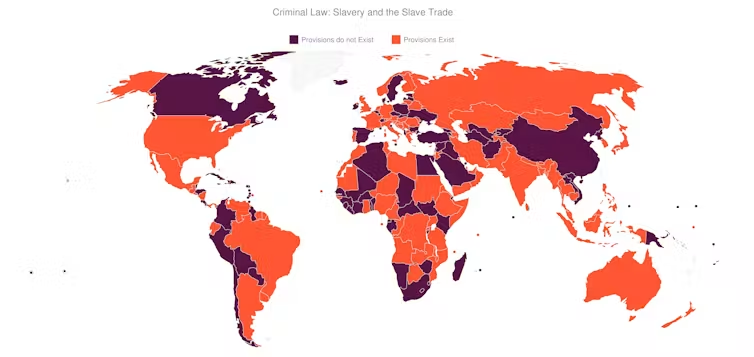
Not only is the failure to prohibit slavery domestically a wrong in the sense that in those countries individuals can not be held to account for enslaving a person; but for the countries themselves, they potentially stand in breach of international law where they have undertaken obligations to prohibit slavery. As to the latter, this holds true for 90 countries, which have undertaken such international obligations but have yet to incorporate the prohibition of slavery in their domestic law.
In drilling down to consider the prohibitions of slavery that countries have undertaken, we found that in a number of instances, where countries had prohibited slavery in their criminal law, they had done so in a limited manner. For instance, some countries only criminalise the “buying and selling human beings” while remaining silent on the exercise of other powers attaching to the right of ownership. Other partial prohibitions of slavery including countries that have only outlawed the “placing or keeping someone in slavery”, holding “a person under conditions of slavery for work or services”, “the compulsory use of labor by a person in respect of whom the powers of the right of ownership are exercised”, and “selling or delivering a person or brokering such action”.
In other instances, countries have done well to capture the essence of the 1926 Convention’s definition of slavery in criminalising the “exercise of a control over another person as one’s property”, while twelve countries have explicitly set out the 1926 definition in their domestic law. Other countries have promulgated blanket provisions that “slavery in all its forms” is to be punished by law.
Assisting Countries in Prohibiting of Exploitation in Domestic Law
Our research found that while 4 per cent of all countries did not have some form of domestic anti-trafficking legislation, the numbers fell off a cliff when it came to the international obligations countries had undertaken to prohibit other types of human exploitation.
This includes forced labour as found in international and regional human rights instruments as well as under the 1930 Forced Labour Convention, of which 94 per cent of United Nations Members States are party, but only 54 per cent of countries have in place penal provisions prohibiting such labour. Also, under international and regional human rights law, the vast majority of countries have undertaken legal obligations to prohibit servitude (89 per cent), and yet it appears that only 12 per cent have in place domestic provisions which prohibit it. Finally, under a 1956 Convention meant to supplement the 1926 Slavery Convention, there is an obligation to criminalise four ‘institutions and practices similar to slavery’: debt bondage, serfdom, servile matrimonial transactions, and the delivery of children for exploitation. Only 64 per cent of UN Members are party to this instrument and, of these, a mere 15 per cent have prohibited these institutions and practices in their domestic law.
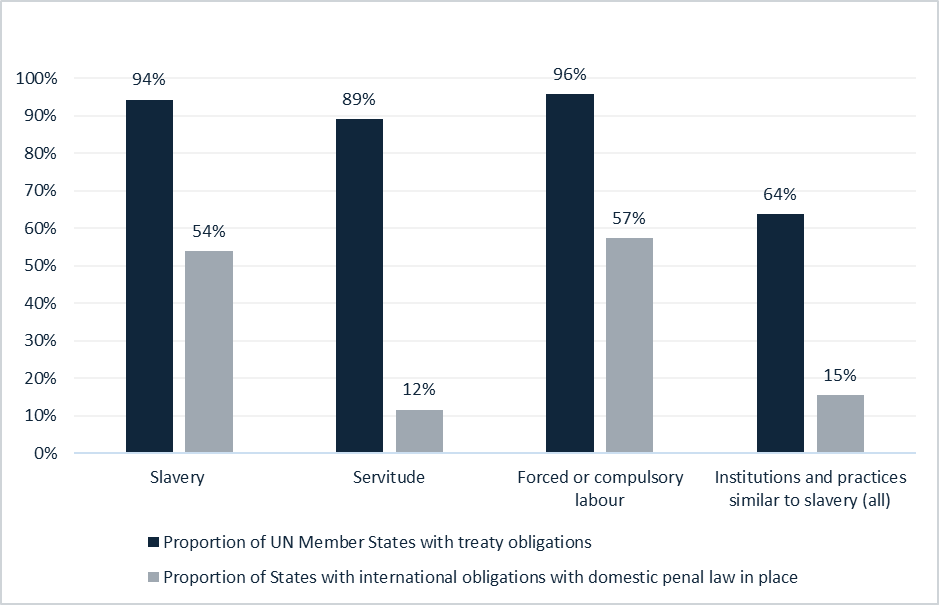
Recognising that 96 per cent of countries already had anti-trafficking legislation in place and for those that remained, they could turn to the UN Office of Drugs and Crime the 2009 Model Law against Trafficking in Persons, we have developed the Anti-Slavery Model Legislation, meant to assist countries by providing a template in addressing the various other forms of human exploitation in their domestic criminal law.
During this, the centenary of the adoption of the 1926 Slavery Convention, it can be said that this instrument has, like of fine wine, come into its own. The solving of ‘slavery’s twentieth-century problem’ has cleared the way for new pathways for addressing human exploitation, most importantly in our estimation is getting countries to prohibit slavery and other forms of human exploitation within their domestic law.
With this in mind, the Anti-Slavery Model Legislation provides a roadmap for closing this gap between a State’s international and their domestic legislative frameworks by criminalising the stand-alone wrongs of not only slavery, but also the slave trade, servitude, forced or compulsory labour, and institutions and practices similar to slavery.


