

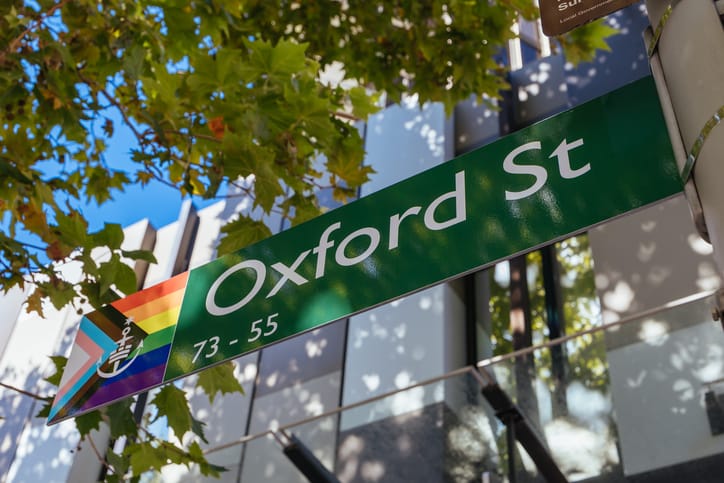
On 12 September this year, New South Wales Police conducted a suite of raids
across queer bars and nightclubs on Gadigal land, near Sydney’s queer capital,
Oxford Street. These followed a round of raids conducted in June, which are still
under investigation by the Law Enforcement Conduct Commission.
Though NSW Police concluded that their internal review of the June/Pride Month
raids found no evidence of police misconduct, the Commission disagreed, and
ordered that they reopen the review to carry out further, ongoing investigations. This comes after Lord Mayor Moore was “inundated” with complaints about police
conduct on the night.
According to Sydney Criminal Lawyers, the two raids resulted in a total of 158
searches, 70 drug detections, and only one charge of supply: a success rate of
0.63%. Though NSW Police Deputy Commissioner Peter McKenna has denied that
these raids were targeted, their timing, geographic concentration, and low success
rate have raised scepticism among community members and politicians.
These raids come at a particularly sensitive time for the queer community, occurring during Pride Month, and then as the trial of ex-NSW Police officer Beau Lammare- Condon – charged with the alleged murder of Luke Davies and Jesse Baird – is underway.
This pattern of surveillance and violence – noting that during the Pride Month raids, patrons reported being shoved, pushed, and forced to remove clothes in full public view – is reminiscent of what are often considered historic instances of police violence towards queer people. For example, the Tasty Nightclub raid in 1994, where 463 patrons were strip-searched, with only one, non-drug-related charge being carried through.
In 1994, like in 2026, the raid was described as unnecessary, and critiqued in queer and mainstream media. Then, like now, police denied any wrongdoing, and suggested that the raid was part of a broader effort to curb drug supply.
The similarities are striking, and in light of conduct from Victoria and NSW Police in recent years, these raids raise questions about whether such conduct really is
historic.
The 2026 raids follow the death of gay man Colin Burling, who died in 2025 after being restrained by a group of NSW Police officers, despite calling out that he could not breathe; the murder of Luke Davies and Jesse Baird in 2024, allegedly by an ex-NSW Police officer using his police-issued firearm; the outing of Dani Laidley by police, while in custody in 2020; the 2019 raid of the Hares and Hyenas bookshop, which resulted in the owner, Nik Dimopulos, having his arm severely broken, and a ruling of no misconduct by the Victoria Police watchdog; as well as numerous incidents of violence towards queer people at various protests in Victoria and NSW in the last five years.
It is in light of these historic, and ongoing instances of police violence towards queer people that the place of police at Pride remains in question. While this debate was raised heavily in the wake of the alleged murder of Luke Davies and Jesse Baird, it is likely that, given these recent raids, it will again find its way into news headlines in the lead-up to planning for the 2027 Sydney Gay and Lesbian Mardi Gras.
These raids also bring into question the sincerity of inclusivity initiatives that
Australian police forces have engaged with in recent years. From formal apologies
for police misconduct towards queer people, which were followed by more violence
towards queer people, to developing LGBTQIA+ liaison officer programs which are
under-funded and under-utilised, the productivity of internal reform efforts has
become an increasingly large, elephant-shaped question in an unaccommodatingly
small room.
Patience with police has worn thin among queer people across Australia, in
particular in recent years and given the culture wars being waged at the expense of
the safety of our trans family. We exist in a national and global climate where the
safety of queer people is precarious, and police raids which can even be interpreted
as targeted, only add fuel to anti-queer sentiment.
So, has anything changed, since Tasty?
In some ways, undoubtedly. The formal apologies, liaison programs and Pride
participation represent a very different institutional relationship with the queer
communities than existed in 1994. But, these changes sit alongside incidents that
evoke remarkably familiar questions about surveillance, violence, and accountability, and which challenge the alignment between corporate police representatives, and those officers who are on the ground.
Perhaps the question of whether the policing of queer communities has changed
was flawed from the beginning. If institutional reform is measured by apologies,
rainbow badges and liaison officers, all while queer people report experiences of
hyper-surveillance, violence and exclusion, then it is worth asking whether these
reforms have changed the experience of policing, or simply the language we use to
describe it.
For communities with a long memory of police violence, this is an important
distinction. As the 2027 Mardi Gras quickly approaches, it is a distinction that queer communities, and the police, will have to tackle.


