


Well, well. Kenyan marathon runner Sabastian Sawe has officially broken through the fabled “sub-two-hour” marathon barrier.
On a reportedly perfect Sunday, 26 April in London, the 31-year-old Sawe ran through the finish gate on the Mall in front of Buckingham Palace’s gilded architectural flourishes in an official marathon time of 1:59.30.
This betters the previous marathon world record by a whopping 65 seconds, the largest single improvement since 2018. The previous world record was held by the late Kelvin Kiptum, also of Kenya. Kiptum’s 2:00.35, set in Chicago in 2023, now somehow seems an entire era away.
In fact, saying Sawe broke two hours is something of an understatement. Such was the brilliance of the moment, Sawe pushed the second-placed Yomif Kejelcha of Ethiopia below the sub-two-hour mark as well, just 11 seconds behind Sawe.
But as we absorb all of this, it’s hard not to wonder: “What next?”
HISTORY HAS BEEN MADE 🫨
— World Athletics (@WorldAthletics) April 26, 2026
Sabastian Sawe becomes the first person ever to break the 2-hour barrier in official race conditions, storming to a historic 1:59:30‼️@KejelchaYomif, on his marathon debut, also breaks 2 hours with a stunning 1:59:41 and @jacobkiplimo2 clocks 2:00:28,… pic.twitter.com/YN1NsdKCDo
My interest as a data scientist and economist (and fellow runner) lies in analysing the historical progression of the men’s and women’s world marathon records.
If sub-two was the driving force behind the marathon in the past decade, what’s left to aim for?
Humanity seems obsessed with the limits of human creativity, ingenuity and performance. We award extravagant prizes for world-firsts and remember the greatest achievements through bronze statues in prominent squares the world over.
But can we actually calculate these limits? Is there a “maths” of human endeavour?
Historical world record progression
Back in 2018, the legendary Eliud Kipchoge of Kenya ran 2:01.09 in the official Berlin Marathon. At the time, many dared to dream Kipchoge could be the one to take the men’s marathon below two hours.
In fact, a year later, Kipchoge appeared to do just that – running a phenomenal 1:59.40 in a tightly-orchestrated “breaking two” display in Vienna.
However awe-inspiring, the Vienna effort would never make it into the official marathon books. The run was contrived in a number of ways, fully understood and acknowledged by Kipchoge and the organisation around him. This was never about the record, but instead, it was, he said, about proving that limits are there to be broken.
Around the same time, I had been working on a statistical approach to modelling the progression of marathon world records over the past few decades. I was intrigued to apply lessons from technological change in economics to the question of human performance.
There are all kinds of factors that feed into a world-record marathon performance. These range from training methods, nutrition, supplementation and biometrics, to performance analysis and, of course, clothing and shoe technology.
However, my approach, drawn from the economics of innovation, is founded on the idea that while performance gains can be made in any of these areas at any time – providing innovation rates stay steady over time – then the next world record marathon performance should be somewhat predictable.
Back then, I estimated that the official men’s marathon would break the sub-two barrier around May 2032. That is, assuming a pretty rare one-in-10 chance on any given marathon day of it happening.
Since then, we’ve had Kipchoge himself break his own record at Berlin in 2022, then Kiptum in Chicago in 2023, and now Sawe in London.
At each point, I’ve adjusted my predictions, since the model can use the new world record marks to improve its accuracy.
My most recent prediction, made in October 2023 for a runner similar to Kiptum, would be that the official sub-two would go down in March 2027. From the perspective of a prediction exercise starting with data from the 1960s, Sawe was just a touch early!
How likely was Sawe’s run?
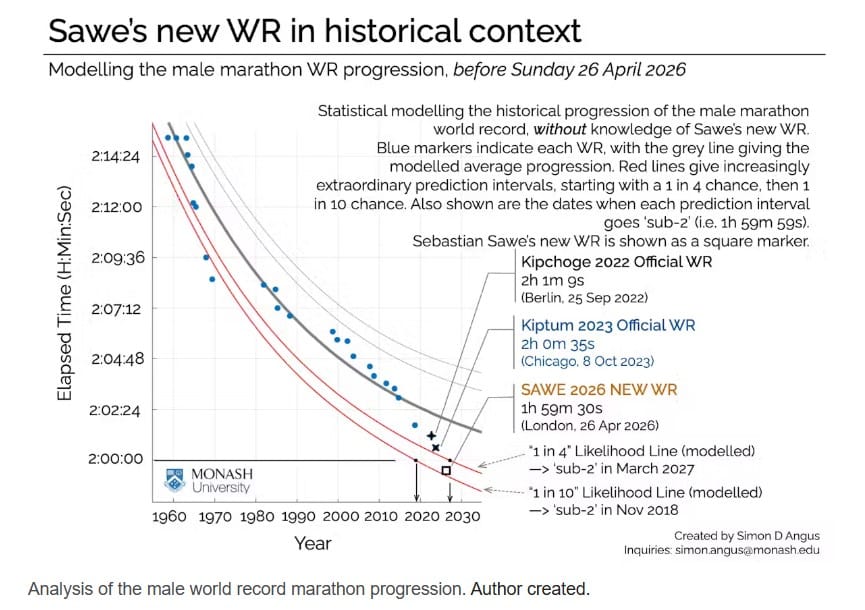
Using my original modelling framework, if we include data only up to Kiptum’s Chicago run in Oct 2023, the likelihood of a sub-two on 26 April 2026 is estimated to be one in 4.29 (just less likely than one in four odds). In other words, pretty likely!
However, this is the likelihood of a run of just under two hours – 1:59.59, to be precise.
But Sawe went well under two hours, so what were the odds of his actual run?
If I use my framework to calculate the odds of Sawe’s actual time on that day, given the sweep of historical world records since 1960, I find the likelihood of 1:59.30 on 26 April 2026 to be one in 7.4 (about two in 15) – that’s pretty rare.
Clearly, a lot of things had to click for the performance that played out in London. And indeed, the backstory already includes:
- the timing of Sawe’s fitness meshing perfectly with the London event
- the importance of getting fuelling and shoe technology right
- the “just so” conditions in London on Sunday (something that was absent in Berlin during Sawe’s previous attempt on the record)
- the competitive environment that saw Sawe pushed by the second-best-of-all-time Kejelcha until the final few hundred metres.
So, what’s next?
My statistical framework uses an assumption that, over time, performance gains get harder and harder to achieve. Any of us who have aimed to improve on our local park run time will know all too well how hard it becomes to eke out more performance gains after the initial euphoria of the first week or two’s improvements is over.
In my model, if we follow the improvement process out for very long time periods, we can estimate the eventual limits of human performance. That is, an estimate of the best possible human marathon time ever. I call it the “limiting” time.
In 2019 when my findings were first published, based on men’s world record times up to and including Kipchoge’s world record of 2:01.39 set in 2018 in Berlin, the limiting men’s marathon time came out to be 1:58.05.
In 2023 I updated this forecast to include Kipchoge’s next world-record time of 2:01.09 (also set in Berlin, 2022) and Kiptum’s astonishing Chicago run of 2:00.35 (2023). At that time, and following the “Kiptum line” – a runner like him closer to the one in four odds line – the new limiting marathon time dropped to 1:55.40.
As I remarked then, Kiptum had given the limits of human performance a real bump.
After Sawe obliterated the men’s two-hour barrier, rerunning my model sees the limiting time once more drop, but this time, not by quite so much.
The new limit comes out to 1:54.00 – a full five minutes 30 seconds faster than Sawe produced in London. In performance gap terms, there’s still about 4.5% of performance gains to be made.
Naturally, there are a lot of inherent assumptions. And such is the exercise that new data points (new world records) tend to have a significant impact on forecasts. Further, we are talking here about the limits of human endeavour – potentially hundreds of years into the future.
The tiniest deviations in a line of forecast today can have outsize impact on a point thousands of days into the future.
Which is a long way of saying, when Sawe’s Italian coach, Claudio Berardelli, hinted that Sabastian might go faster on a better-suited course such as Chicago or Berlin, I for one, will not be surprised.
The statistical arc of human endeavour in the marathon keeps bending upwards. There’s still much to be inspired by.

This article is republished from The Conversation under a Creative Commons licence. Read the original article.


