

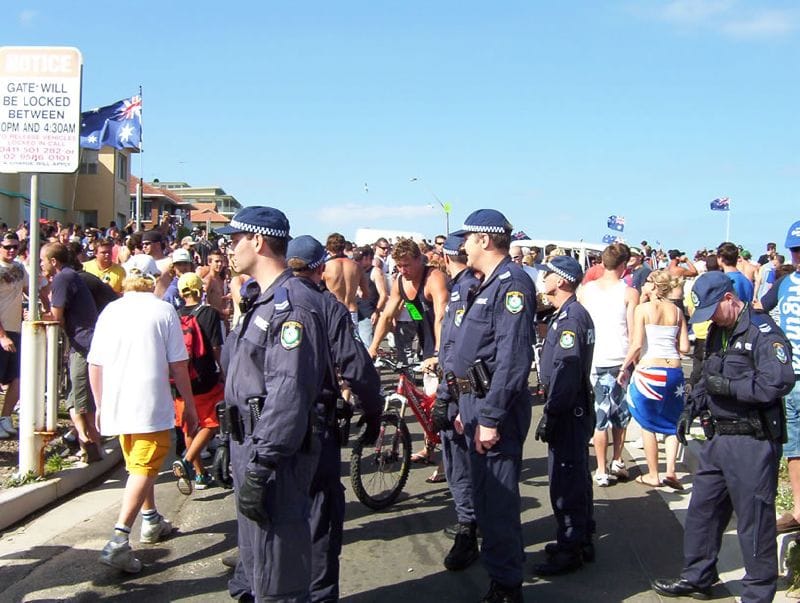
Two decades have passed since widely-circulated text messages urged white Australians to gather on Cronulla Beach to participate in a “Leb and Wog bashing day”.
On 11 December, 2005, 5000 people responded to this call to action, gathering at North Cronulla. For many, it was imperative to “reclaim” the beach from diasporic Middle Eastern communities residing in Sydney’s western suburbs.
A fight had taken place between surf lifesavers and young men of Middle Eastern background the previous week, although locals alleged that they had been repeatedly affronted on the beach for years. These claims did not find support from the police’s later analysis of their records and crime statistics.
Serious racist violence took place at Cronulla. More than 50 people were charged with offences. Beer bottles were hurled at police officers and an ambulance deployed to treat people who were assaulted because they were “of Middle Eastern appearance”.
Meanwhile, transit officers likely saved the lives of two men of Middle Eastern background, fighting off a mob who set upon them after hearing they had arrived by train.
Then came the reprisals. Over the next few evenings, men of Middle Eastern background retaliated, engaging in serious property damage and physical violence at beachside suburbs in the south and southeast. The fact that the reprisals were mobile – with Middle Eastern men moving by car, and in convoy – meant they were challenging for police to respond to.
As a consequence, the riots and reprisals led to the introduction of “emergency” police powers via the Law Enforcement Legislation Amendment (Public Safety) Act 2005. Perhaps most noteworthy among them were “lockdown powers” entailing road blocks. These powers attracted considerable attention and questions were rightly raised about the prospect of them impinging upon people’s civil liberties.
I was in NZ when Cronulla happened & people I knew were getting messages to come down to support Arabs/Muslims. It wasn't just a national event but a geopolitical one with lasting effects. The beach was an extension of the border & Muslims the invaders. https://t.co/4ItNDL5qBY
— Glumcore (@theprimalplot) December 8, 2025
It’s less well-known that the police response to the reprisals also saw the establishment of the Middle Eastern Organised Crime Squad (MEOCS), staffed by more than 100 police employees. This was despite the police concession that most of the men involved “had little or no criminal records”.
The police have also confirmed that it’s impossible to determine whether those people arrested and charged by the MEOCS were in fact Middle Eastern.
Meanwhile, data I obtained via Freedom of Information request indicates that a third of the charges laid by the MEOCS during its 11-year tenure were for traffic-related offences (33.57%). Police often find vehicle stops and traffic offences useful because they facilitate intensive surveillance and information-gathering. But those on the receiving end tend to experience such stops as patterned police harassment.
The MEOCS also made extensive use of controversial Firearms Prohibition Orders (FPOs). Counterintuitively, FPOs can be issued to people who have never committed any crime, let alone gun crime.
In turn, those subject to them can be stopped and searched by police at will. Police in New South Wales developed a methodology of issuing FPOs to members and associates of certain Middle Eastern families to enable surveillance.
But while police may be motivated to “disrupt” and encumber criminal groups, this methodology creates the potential for people of Middle Eastern background to be intensely policed for who they are, and not because they’ve engaged in substantive wrongdoing.
The Raptor factor
Although the MEOCS was disestablished in 2017, its work continues today through Strike Force Raptor. Raptor’s former commander was candid in explaining that its officers “lawfully harass [its targets], making them uncomfortable to the point … they get arrested and are incarcerated, or they desist from their activities”.
Further data that I obtained via Freedom of Information request shows that, like the MEOCS, one-third of charges laid by Raptor’s officers have been for traffic and vehicle-related offences (34.83%).
This model appears to have had direct influence upon policing in Victoria in two key respects.
Firstly, Raptor provided somewhat of a blueprint for Victoria Police’s VIPER Taskforce. In turn, VIPER’s officers – and Victoria Police more broadly – have expressed intentions to expand their use of FPOs to exploit the search powers they entail, like their New South Wales counterparts.
Given widespread concerns about serious and violent crime in the Garden State, perhaps such practices would find public support.
However, the lessons about targeted and discriminatory policing arising from my research in New South Wales, when coupled with the recent findings regarding Victoria Police’s racial profiling of Middle Eastern people, should prompt reflection and reconsideration.


