

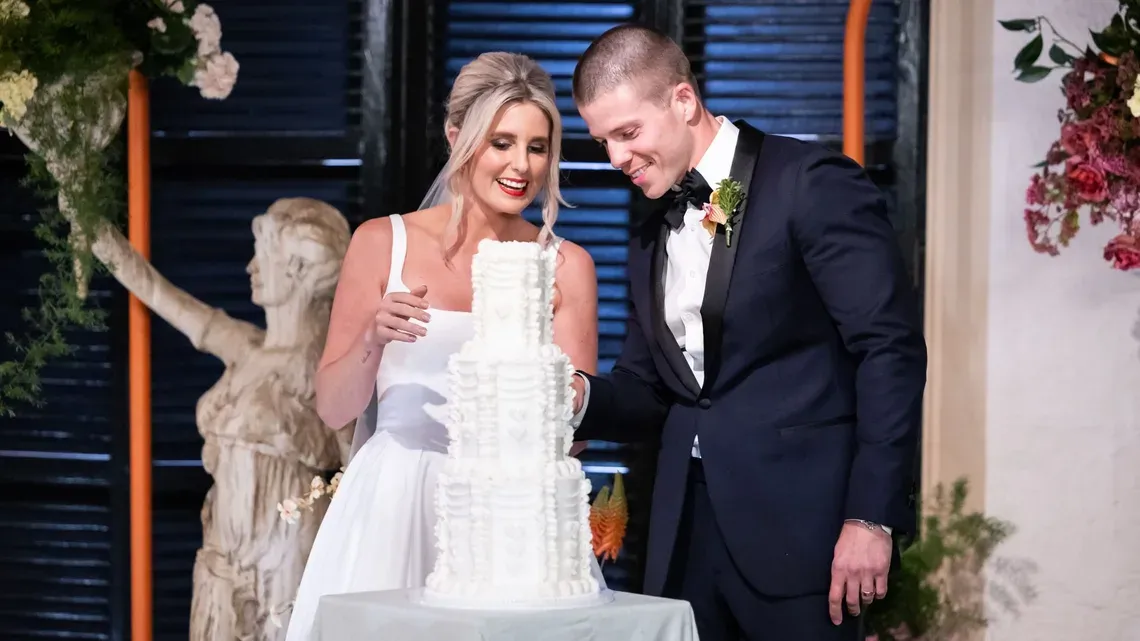
Australia’s popular commercial TV show Married at First Sight offers entertainment to millions of people across the country each week. At the same time, its episodes frequently raise contentious talking points, especially when it comes to gender dynamics in contestant relationships. And, more precisely, the problems of unequal gender relations.
A particular segment from a recent episode, which is now doing the rounds prolifically on social media, speaks clearly to this issue.
For us, as researchers examining the link between manosphere content and ideologies and gender-based violence, the clip raised serious concerns.
While the show’s history is littered with swathes of problematic men and attitudes, this latest viral exchange signals old sexism with a new twist.
Enter the issue of so-called “masculine energy”. A groom on the show, when articulating his list of expectations for a prospective relationship with his contestant “wife”, described himself as an “alpha” and explained that relationships only work when “energies” are properly aligned.
Drawing on various manosphere-generated idioms and talking points, the implication here is that men are wired to lead, while women are wired to nurture. “Energies” here is actually code for various elements involving the dynamics of power and submission but, essentially, he’s articulating the level of resistance he’s willing to accept from an ideally docile and compliant partner.
The problem, he suggested in this episode, was that his bride also had “masculine energy” (manosphere code for sharing independent thoughts and ideas, seeking independence outside of the relationship and home) and that this is unworkable because it would be like “two alphas” clashing.
In a manosphere-encoded relationship, one person must be in control of all resources (including money and power) at all times, and a woman possessing or expecting these resources herself presents a problem for a male partner who then struggles to understand his purpose and function.
What we read from that interaction is not personal insecurity or preference, per se, but something grounded in pseudo-scientific and misinformed interpretations of human biology – that “energies” are attached to sex or gender, that “masculine” energy is grounded in biology, rather than social explanations, and that the notion of men as providers and carers is inaccurately grounded in “traditional” roles with ancestral precedence.
When the bride questioned the premise put to her, her discomfort was reframed as a misunderstanding of nature. Her confusion was further offered to us by her articulation of a belief in “equality” but an eschewing of feminism, a disclosure indicating we have a lot of work to do in undoing manosphere discourses that have become neutralised and mainstream.
Put simply, this contestant drew on biological essentialism, which takes particular questions about who gets to decide, who gets to lead, who is expected to nurture, and collapses them into neutral facts about human wiring, ignoring that these are socially and culturally-influenced power arrangements, not simply roles that are natural.
If men are dominant because biology demands it, then social inequalities stop looking like political choices and start looking like inevitabilities. That’s why this discourse is so powerful – disagreeing with it feels like rejecting the very nature of humanity.
‘Alpha’ isn’t biology, it’s branding
To the groom’s specific language, let’s begin by underscoring that the “alpha male” ideal that many men subscribe to is itself a myth. It grew out of early studies of captive wolves that were later repeatedly discredited; research on wild packs showed they function more like family groups than dominance battlegrounds.
There’s no scientific basis for the pop-cultural alpha as a biologically-destined ruler. Yet the simplified version persists, repackaged as proof that the gender hierarchy – of men over women and gender-diverse folks, and one man over other men – is natural.
New MAFS groom Tyson Gordon said he's looking for a wife who is "submissive".
— Yahoo News Australia (@YahooNewsAU) February 23, 2026
FULL STORY: https://t.co/5UdpEGN6tM#MAFSAU pic.twitter.com/AxwvT8D5Zg
More broadly, the claim that men are the natural leaders and protectors of human societies does not withstand scrutiny.
Cross-cultural research, including studies of matriarchal societies, shows no evidence that male dominance is universal or biologically determined. The belief that leadership and protection are inherently male traits is not timeless. It’s historically produced and culturally sustained.
Now, to this rhetoric of masculine energy that has recently become more widespread. It’s not an accident. Over the past couple of years, we’ve seen public figures in tech and business talking about masculine energy, not as a quirky metaphor, but as something workplaces and cultures need more of.
Most famously perhaps, Mark Zuckerberg, for example, has invoked this language in discussions about leadership and innovation in ways that make it sound aspirational and uncontroversial. That may seem like a branding move, but it’s part of a broader pattern where hierarchical gender norms are dressed up as timeless truths.
This resurgence is shaped by converging cultural forces – post-truth politics that blur fact and opinion, conservative backlash against gender equality, the return of “strongman” political leadership, the mainstreaming of manosphere discourse, and digital cultures that reward simple, emotionally-resonant explanations.
In this context, phrases such as “masculine energy”, “sexual polarity” or “gender balance” are detached from their political origins and repackaged as self-development or common sense.
Emboldening behaviours
What this obscures is that these ideas are political. They draw on longstanding dynamics of gender hierarchy.
Our recent work on the reanimation of normative manhood acts shows how, in schools, behaviours such as dominance, harassment, derision and defiance, often shaped by online misogynist cultures, are becoming more visible and emboldened in everyday interactions.
Normative manhood acts are performances that reproduce gender power. They assert authority over women and dissenters, ridicule challenges to male dominance, and position entitlement as natural.
These practices are no longer confined to fringe spaces. They’re surfacing in schools, workplaces and mainstream entertainment.
That’s what makes the MAFS moment more than just awkward and/or emotional “car crash” television. Reality TV trades on a promise of authentic glimpses into “real” relationships.
When producers and network social media circulate clips of a man explaining why women should take a subordinate role and then frame it as just a quirky trend, they normalise a particular gender script.
What should be recognised as the early scripting of a coercive dynamic gets turned into a conversation about compatibility instead of power. When hierarchy is framed as destiny, the space for equitable relationships narrows.
None of this is unexpected. Backlash against gender equality has been building for years, fuelled by political movements, digital subcultures and economic uncertainty.
The task now is to recognise how these narratives circulate and become normal. When dominance is presented as nature and submission as fulfilment, we’re not observing biology. We’re watching an ideological project embed itself in the mainstream.


