


Three years ago, Monash University and Peninsula Health’s National Centre for Healthy Ageing (NCHA), a think tank and research facility looking at Australia’s ageing population, opened Australia’s first and only digital library.
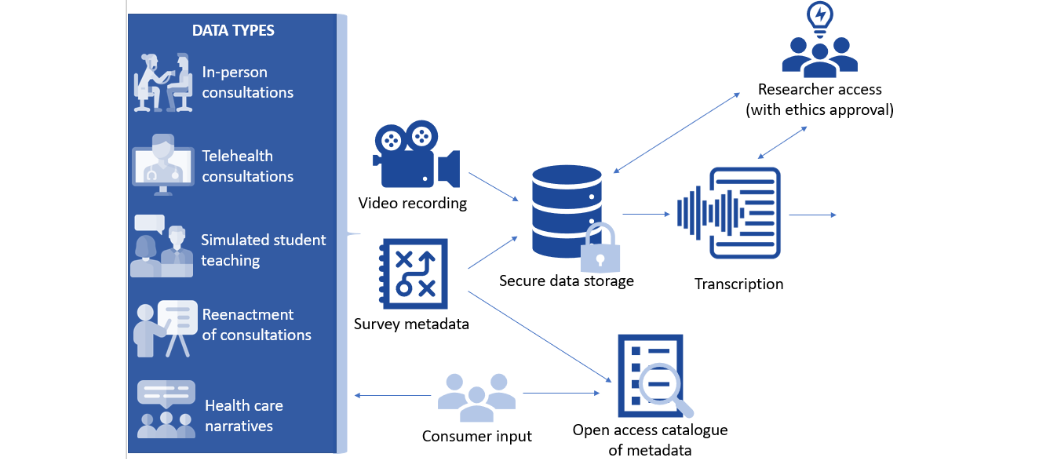
This library houses real-world video-recorded interactions from across all parts of the healthcare system, including community health and primary care, hospitals and other acute settings, and also aged care facilities, telehealth and outreach services.
As a substantial piece of research infrastructure, it provides a window into real-world consultations. The primary idea is to support healthcare communication research and education, and thereby improve consumer satisfaction, healthcare safety, outcomes and quality.
Now, for a new study in the Australian Journal of General Practice, researchers have used this unique library, housed at Monash’s Peninsula campus, to dig into the complexities of general practice and how it relates to “whole-person care”.
The study investigated how many different health topics were discussed in 54 patient-GP consultations, demarcating each item as discussed in depth, or mentioned. Items recorded were in line with the International Classification of Primary Care system.
Most patients were over 45 and women (51.9%). On average, consultations lasted 19 minutes, and eight different health issues were discussed per consultation. The range of time per consultation went from a scant three-and-a-half minutes to almost 40 minutes. Half of all the consultations covered cardiovascular health and musculoskeletal problems, with one-third covering psychological health.
Supporting the clinical workforce
Dr Kimberley Norman, a research fellow in the School of Primary and Allied Health Care, says the library is a valuable opportunity to understand what really happens in clinician-patient consultations to identify ways to improve healthcare for patients and better-support the clinical workforce.
“It is unique in Australia and brings new possibilities for improving healthcare communication,” she says. “This world-leading research infrastructure provides a window into real-life consultations, and that was crucial for our research objectives.”
The Digital Library also includes anonymous transcripts and demographic data, as well as a post-GP consultation survey with the patient rating the experience of the consultation.
The Monash research was led by general practitioner and academic Adjunct Professor Liz Sturgiss from the School of Primary and Allied Health Care, who set up the Digital Library in 2022. Nilakshi Gunatillaka and Dr Kimberley Norman were joint lead authors with Dr Kellie West, a practising rural GP and researcher.
The library is unique to Australia, but there are others – the largest is in the Netherlands, at the Nivel Research Communication Center in Utrecht. They’ve also been established in the UK and New Zealand.
The researchers point out in the new paper that these archives of real-life doctors’ appointments eliminate what’s called “recall bias”, where research is compromised by less-than-exact recollection of events or experiences.
The paper uses dialogue of the interactions as “excerpt quotations”, which show GPs and patients talking about or mentioning depression and medication, weight, bowel cancer tests and smoking. More than half the patients (55.5%) were on a low or limited income.
The healthcare ‘dual crisis’
The paper explains that standard GP appointments can be complex and should be considered “in the context of a possible 144 consultations per week per full-time GP… these study findings are consistent with existing literature on the consistently evolving and complex nature of GP-patient interactions.”
It says GPs and medical students have an “intense cognitive load” that makes it “unsurprising” that Australian primary healthcare experiences the “dual crisis of high GP burnout and low medical student recruitment”.
This “strained” workload leads to high levels of GP burnout, as well as worldwide shortages of new medical trainees in primary healthcare.
“We, and others, anticipate widespread future workforce issues,” the paper says, “if no substantive action is taken by policymakers to address these concerns.”
NCHA Director Professor Velandai Srikanth says the research shows how the Digital Library can reveal the complexity of GP healthcare.
“Through such research and knowledge translation, it has the potential to enhance interactions in a number of areas relevant to healthy ageing and beyond, from primary care right through to complex specialist care.
“The ultimate beneficiaries will be both the provider and recipient of healthcare.”


