

Australia’s most comprehensive study into the health and social issues affecting women and girls has been published, and its findings are confronting.
Violence against women was identified as the top health concern, while endometriosis, depression and homelessness were listed as areas most in need of greater funding and support.
Conducted by Monash University researchers in partnership with, and funding by, The Sisterhood Foundation, the landmark study reveals that women’s and girls’ health is routinely overlooked, underfunded and misunderstood.
The ‘Women deserve better’ report shows that women’s health is still largely viewed through a reproductive lens. While pregnancy, fertility and gynaecological conditions must receive attention, many other health conditions that affect women exclusively, differently or disproportionately remain neglected.
As one participant noted, it’s time to go “beyond the bikini line” and recognise the full spectrum of women’s and girls’ health needs, because women do not stop having health concerns outside their reproductive years or beyond their reproductive organs. Failing to address these needs undermines health equity across the life course.
Published in BMC Women’s Health, the study was led by Dr Sara Holton and Professor Helen Skouteris, and is the first Australian research of its kind. It combined a national survey, in-depth interviews and a review of health research funding, academic publications and media coverage.
More than 2200 women and girls participated in the survey, alongside interviews with health and social care experts, including clinicians, policymakers and academics. Together, their insights revealed a wide range of “silent” health issues – conditions that receive little recognition, understanding or support.
These include female sex-specific conditions such as endometriosis and menopause, as well as conditions that affect women at far higher rates than men, including cardiovascular disease, depression and gender-based violence.

Dr Holton says the lack of visibility regarding these issues has real and lasting consequences.
“This silence has resulted in significant inequities in women’s and girls’ access to healthcare, health outcomes and participation in research,” she says.
Katie McLeish, Executive Officer of The Sisterhood Foundation, says the findings reflect what many women already know from lived experience.
“Too many women and girls feel unheard or dismissed when it comes to their health. They’re calling for greater attention and support for the issues that affect them. We need to listen,” she says.
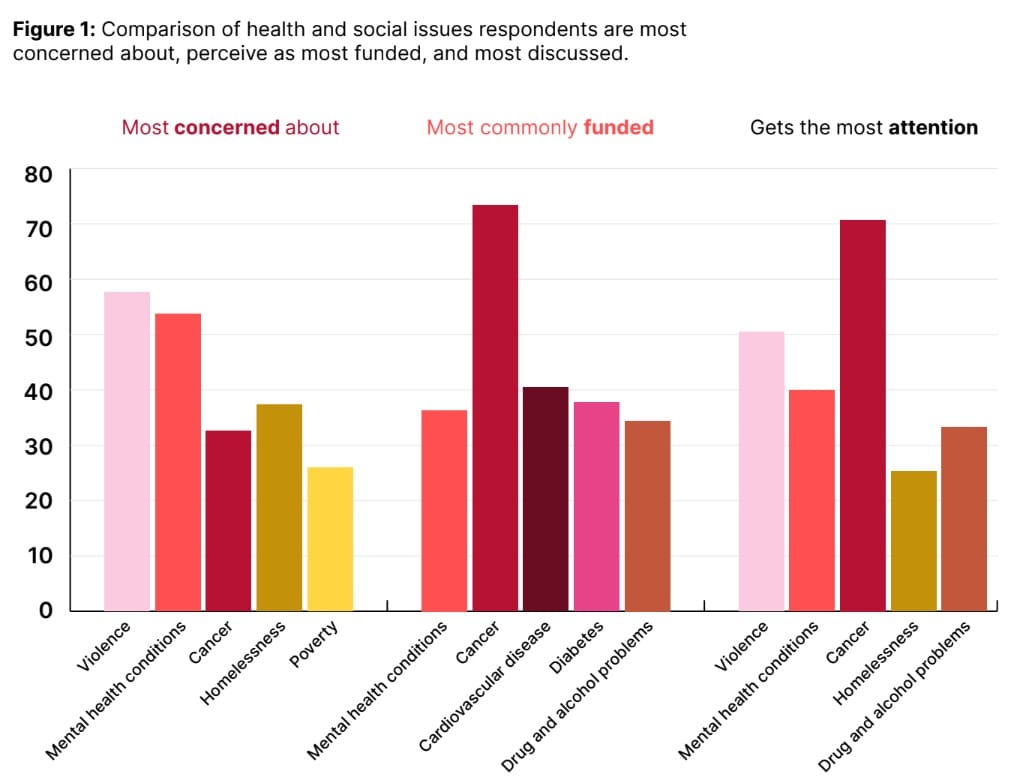
More than 50% of survey respondents identified violence as their top health concern (57.6%) and cancer was perceived as receiving the most funding (73.3%) and attention (70.7%).
The study also exposed stark funding gaps. Of more than $3.5 billion in Australian health research funding allocated in 2023-24, just 3.3% supported women’s health research. More than half of that funding went to reproductive health and gynaecological cancers. Conditions that affect women disproportionately or differently, such as chronic kidney disease, depression and violence, received the least funding.
Central to the findings is the distinction between equality and equity in health. Treating women and men the same does not produce fair outcomes when health systems are largely designed around male bodies and experiences.
Equity recognises that women face different risks, experience different symptoms and encounter different barriers to care, and therefore require targeted investment and tailored approaches. Without an equity focus, existing gendered disparities are reinforced rather than reduced.
Professor Skouteris says these disparities stem from a longstanding “one size fits all” approach to health care.
“Health research and practice have historically been based on data collected predominantly by and about men. This leads to generalised care models that overlook women’s unique health needs and that reinforce gendered assumptions about their bodies,” she says. “As a result, women are more likely to have their symptoms dismissed, be misdiagnosed, receive delayed treatment, experience multiple illnesses and be excluded from health research.”
The findings make one message unmistakably clear – many women’s and girls’ health issues have been left in the shadows for far too long. As one participant put it simply, “women’s health does matter”.
Achieving real change requires listening to women, targeted investment, and an equity-driven approach that reflects women’s lived realities. And that change is needed now.


