

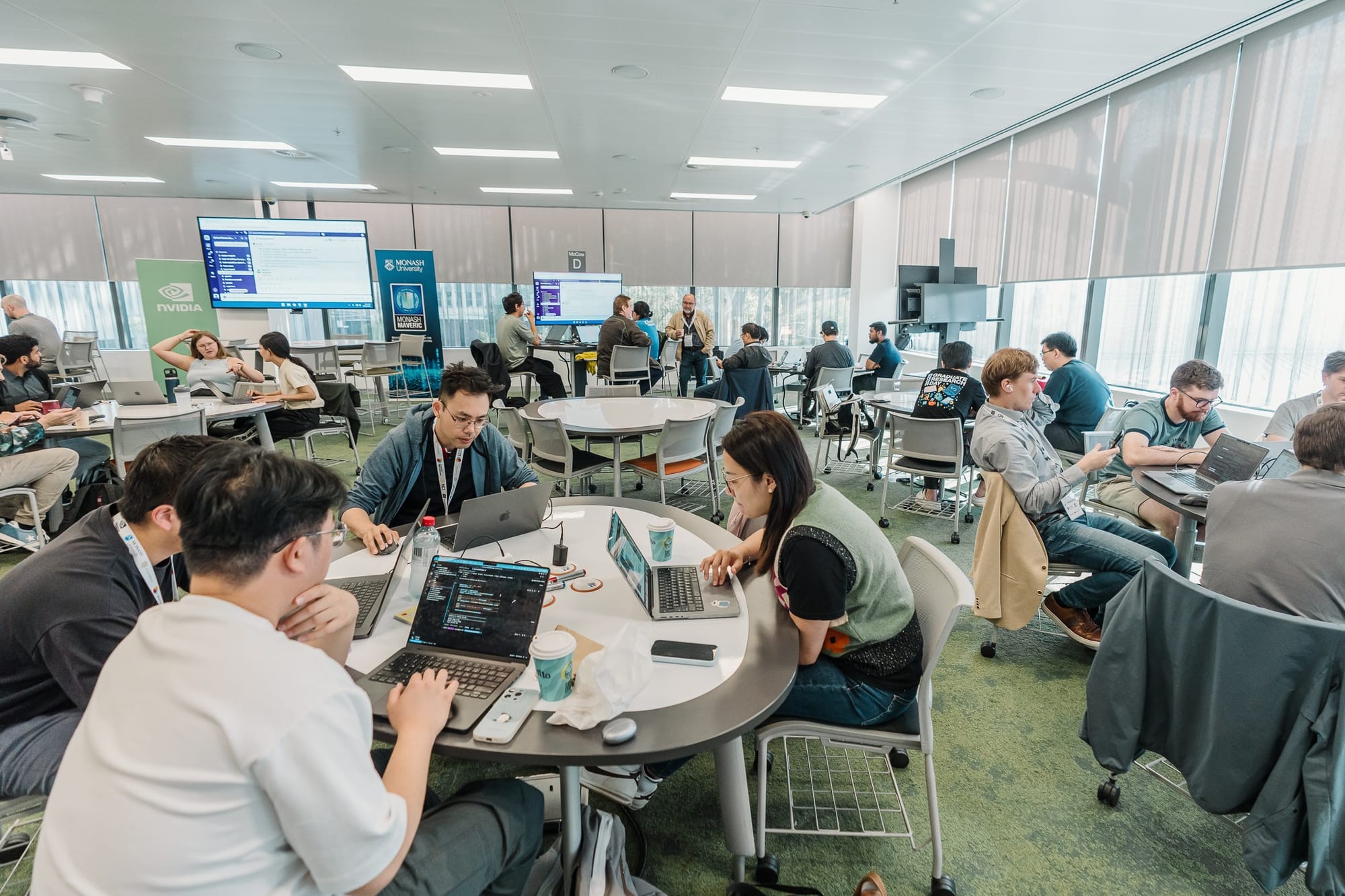
What happens when you put top scientists, AI experts and serious computing power in the same room? At Monash University, the NVIDIA and OpenACC AI for Science Australian Hackathon set out to answer exactly that.
Think less “conference”, more “code sprint with purpose”.
From idea to prototype in a matter of days
At the heart of the hackathon are intensive team sprints. Researchers don’t just talk about ideas, they build them.
In just a few days, teams used AI to turn early-stage concepts into working prototypes addressing everything from identifying therapeutic targets in paediatric brain cancer through to helping farmers know exactly where their crops need to be planted, and when.
It’s the kind of rapid experimentation that would normally take weeks or months, but in this case it’s compressed into a single, focused burst of collaboration.
Where science meets AI expertise
This isn’t a solo effort. Researchers earned their place through a competitive application process, and once inside, they were paired with mentors from NVIDIA, Monash, Australian BioCommons and National Computational Infrastructure (NCI) Australia.
That mix of deep domain knowledge and hands-on AI expertise is where the magic happens.
You’ve got scientists who know the problem inside-out, working side-by-side with AI specialists who know how to scale solutions fast. The result? Real progress, in real time.
Building Australia’s AI-ready research workforce
Events like this aren’t just about short-term wins, they’re about enhancing long-term AI capability.
By giving researchers direct access to tools, infrastructure and expert guidance, the hackathon helps build confidence in using AI in their own fields. And that matters, because AI is quickly becoming a core part of modern science.
One of the projects was to focus on solving a real agricultural challenge in the Western Australia southwest cropping region. In a short amount of time, they built a system that could analyse individual farm paddocks at scale, processing detailed satellite data across more than 267,000 paddocks each year.
The team redesigned how the system works behind the scenes so it can run much faster and handle more data at once. This means it can more accurately identify crops and predict yields in a fraction of the time.
They’ve also built a simple, easy-to-use interface, so farmers and local decision-makers can quickly understand the results and use them to make informed decisions.
Even older systems received a major upgrade. One team showed that by using newer technology, they could dramatically speed up traditional models and apply advanced AI to problems it hadn’t been used for previously.
It’s a strong reminder that you don’t always need to start from scratch – existing tools can still deliver powerful results when paired with modern computing.
Aligned with MAVERIC
The event also builds on Monash’s investment in MAVERIC, Australia’s first university-based AI supercomputer featuring the NVIDIA GB200 NVL72 platform – the first deployment of its kind in Australia.
The advanced AI supercomputer has used first-in-Australia technology to solve complex problems across a vast and multifaceted span of human endeavours.
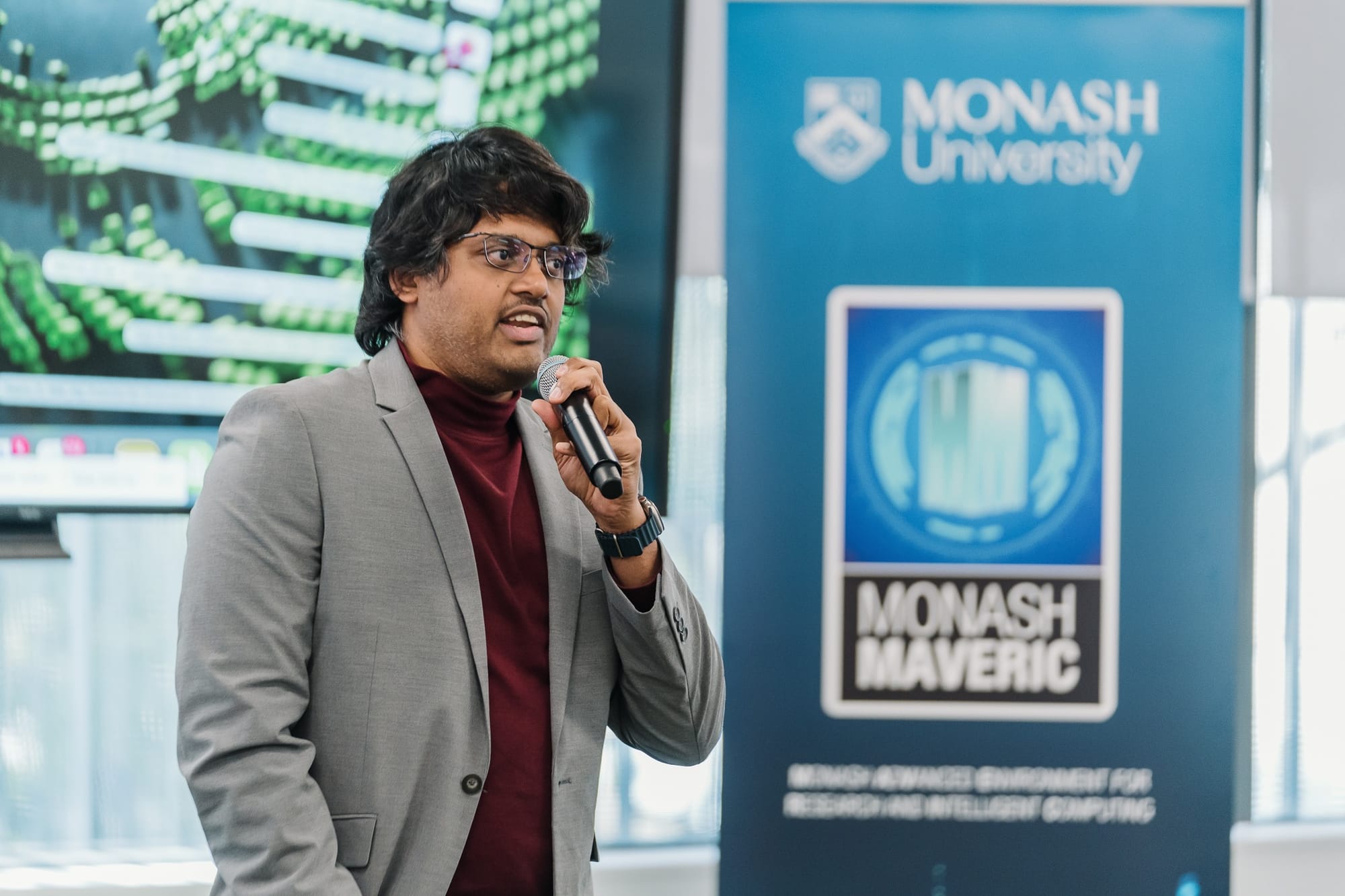
Importantly, the hackathon gives researchers hands-on experience in building and refining AI models in a high-performance environment, helping them prepare to scale their work onto systems such as MAVERIC, where ideas developed in days can be expanded to tackle real-world problems at much greater speed and scale.
Collaboration at scale
The teams reflected a truly national effort, with researchers from Monash, Hudson Institute of Medical Research, University of New South Wales (Sydney), Department of Primary Industries and Regional Development (Western Australia), ACCESS NRI and the National Oceanic and Atmospheric Administration (NOAA), and La Trobe University.
Supporting partners included NCI Australia, Pawsey, Australian BioCommons and Sharon AI. In other words, a full-stack ecosystem for AI-driven science.
Why it matters
What makes this hackathon stand out isn’t just the technology, it’s the pace and the collaboration.
When you bring together the right people, the right tools and the right support, you don’t just accelerate research, you change how it happens.


